Mortar Joints Letting Water In
Open joints in parapet brick let rain soak down inside the wall. The stain shows up on an inside wall well below the roof. Cutting new counterflashing into the joint seals the roof edge at the wall.
As a Red Cloud commercial roofing contractor, we replace roofs on older downtown brick buildings, tying new membrane into parapets, scuppers, and masonry walls.
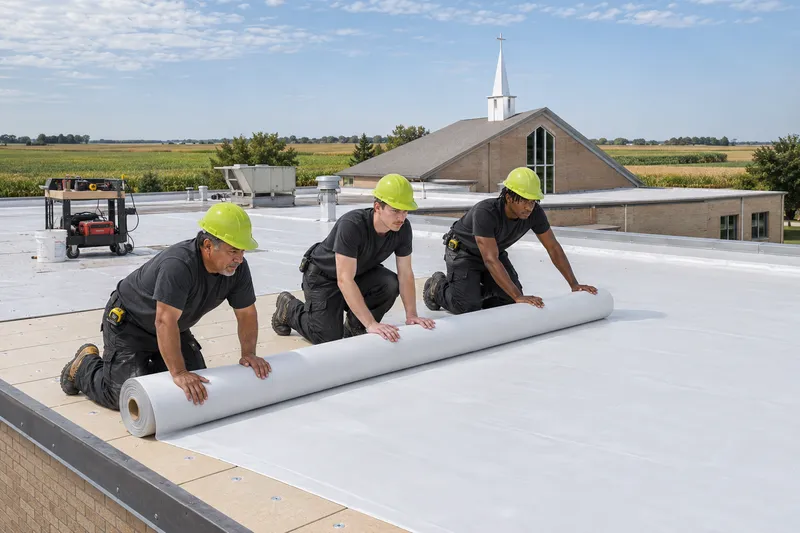
Red Cloud commercial roofing on older downtown buildings is shaped by the masonry. Parapet walls, scuppers, and brick joints decide where water goes, where it gets in, and how the new roof ties into the walls.
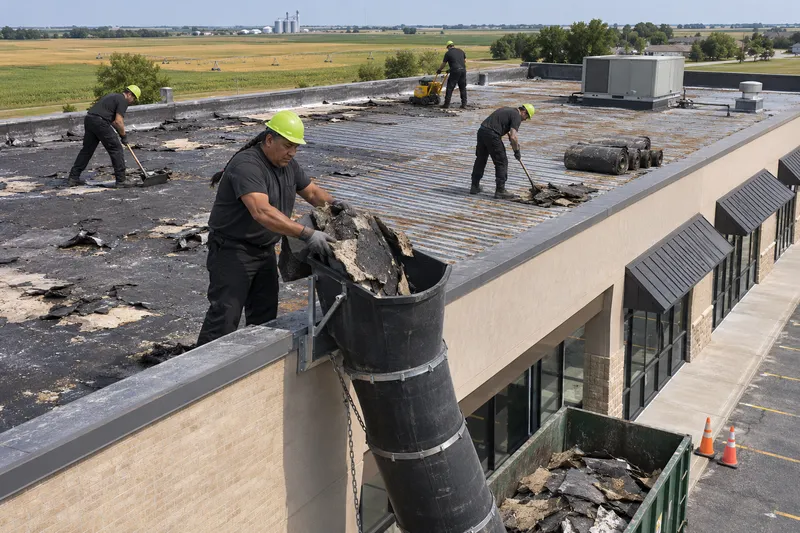
We tear off the old built-up layers, check the deck, and cut counterflashing into the brick so the new roof seals at the wall instead of relying on caulk.
Older brick buildings downtown share these roof conditions.
Open joints in parapet brick let rain soak down inside the wall. The stain shows up on an inside wall well below the roof. Cutting new counterflashing into the joint seals the roof edge at the wall.
Old metal scupper boxes rust at the seams and leak into the wall. New boxes get flashed into the membrane and the masonry. Rusted boxes also let water into the brick around the opening.
Decades of reroofing can leave heavy built-up layers on the deck. Tear-off shows the deck condition and removes weight. Several layers can also hide soft deck underneath the top sheet.
Metal counterflashing set in caulk instead of a mortar joint pulls away over time. New pieces get set into a cut joint. Fresh pieces set in a cut joint stay put through freeze and thaw.
Roofs that drain to one wall often pond on the far side. Tapered insulation moves the water toward the scuppers or new drains. Standing water ages the membrane around it much faster.
Wood decks under long-leaking roofs soften at the low spots. Bad boards are replaced before new insulation goes down. Soft boards get found during tear-off and replaced before board goes down.
Older downtown roofs and newer buildings in town each fit a different system.
Flat downtown roofs with odd-shaped walls and penetrations, where flexible flashing wraps every corner.
EPDM Roofing detailsLow-slope roofs where a welded white sheet and prefab corners suit the layout.
TPO Roofing detailsPitched shops and storage buildings around town with worn steel panels.
Commercial Metal Roofing detailsLarger processing or storage roofs that need phased work around operations.
Industrial Roofing detailsStains low on a brick wall often start at the parapet or a scupper. We check both on the roof walk.
At the walls and scuppers, the difference is easy to see.
Brick buildings get the walls done with the roof, in this order.

We walk the roof and parapets, count the old layers with core cuts, and check each scupper and mortar joint. Interior stains get traced back to the wall or scupper above them.
Built-up layers come off to the deck, and soft boards at old leak spots are replaced. Debris leaves by the alley, away from the storefront.
Tapered board slopes the roof toward the scuppers or new drains so water leaves the roof. Crickets go behind wide curbs and at parapet corners.
Membrane covers the field and runs up each wall, and new scupper boxes are flashed in. Curbs and pipes are flashed as the field goes down.
A mortar joint is cut along the wall, and counterflashing is set into it and sealed over the base flashing. We walk the roof and walls with you at the end.
Red Cloud is in our service area along with Hastings and four other towns.
Building in a different town? call us or send us a message.
Home base for TPO, EPDM, industrial, and metal roofing.
Storefront roofs and ag buildings with staging planned ahead.
Flat main-street roofs with insulation and parapet work.
Shop and co-op roofs where layers and ponding set the scope.
Metal shop roofs and farm-service buildings.
Parapet walls, scuppers, and masonry usually shape the scope. Flashing has to tie into the brick with proper counterflashing, old built-up layers usually come off so the deck can be checked, and tapered insulation can move water to existing scuppers or new drains.
Tear-off of old built-up layers, deck repairs, and masonry flashing work add the most. Scupper replacement and tapered insulation are listed as separate line items.
Material and debris move through the alley where possible, and sidewalk cover goes up when work faces the street. The shop below stays open while each section is roofed.
Call us with the address. We walk the roof, check the parapets and scuppers, and send a written scope.
Usually, yes. Tapered insulation slopes water toward the existing openings, and new scupper boxes are flashed in. A new drain is added only where one wall cannot carry all the water.
We cut and reset mortar joints where counterflashing goes in and seal open joints at the roof line. Larger repointing across a whole wall belongs to a masonry contractor, and we coordinate the schedule.
Water that enters at a parapet or scupper runs down inside the masonry and appears lower on an inside wall. The roof walk checks the wall top, the flashing, and the scuppers above the stain.
Yes. Tearing off several built-up layers and gravel removes a lot of weight, and a single-ply membrane over insulation weighs far less than what came off.
Call or request an estimate. We check the roof, the parapets, and the scuppers on one visit.