Two Roofs Already on the Deck
A roof with two existing layers leaves no room for a recover. Tear-off to the deck comes first, and the local building office confirms code limits. Removing both layers also shows the deck condition for the first time.
As a Kenesaw commercial roofing contractor, we check layers, deck, and drainage, then install TPO, EPDM, or metal on shops and co-op buildings.
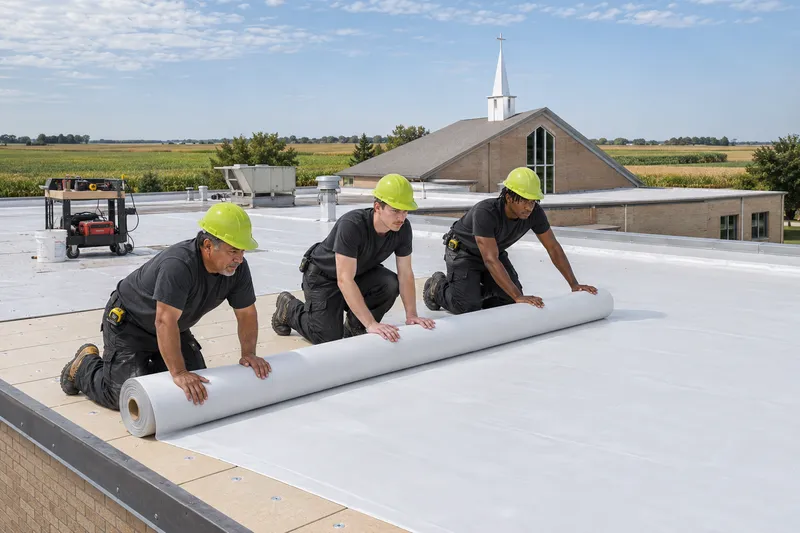
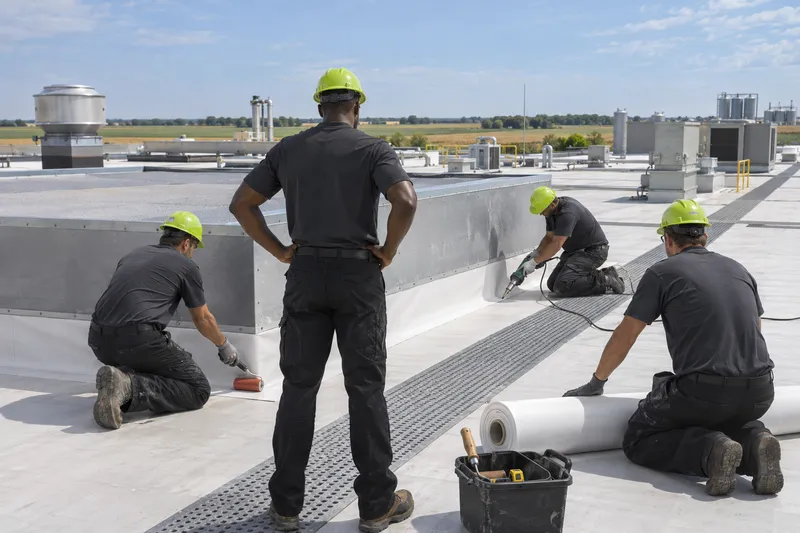
Kenesaw commercial roofing decisions start under the old roof. How many layers sit on the deck, whether the insulation is wet, and where water ponds decide between a recover and a full tear-off.
Core cuts answer those questions before the bid, so the scope fits the roof you really have and the price does not jump once the old roof comes off.
These conditions decide whether a Kenesaw roof can be recovered or has to come off.
A roof with two existing layers leaves no room for a recover. Tear-off to the deck comes first, and the local building office confirms code limits. Removing both layers also shows the deck condition for the first time.
Insulation that holds water rots the deck and blisters a new roof. Wet sections come out even when the rest stays. Core cuts mark the edges of the wet area before the bid.
Low spots that hold rain need tapered insulation. A recover alone keeps the same low spots. Tapered board under the new roof gives each low spot a path to the drain.
Steel shop buildings from decades past were framed for light roofs. A structural check comes before any heavier system. A check of purlins and connections comes before any added weight.
When the roof around a drain sags, the drain sits above the water. Resetting the drain and adding tapered board fixes it. A reset drain sits at the lowest point of the new roof.
Units and vents on short, rusted curbs leak at the base. New curbs go in during the reroof. Taller curbs give the new flashing room to turn up the side.
Once the deck and layers are known, the system choice follows the building.
Flat shop and office roofs where a welded white sheet goes over new tapered board.
TPO Roofing detailsRoofs with many pipes and vents, or a single dry layer that can be recovered.
EPDM Roofing detailsPitched shops and storage buildings, after the structure is checked for the panel weight.
Commercial Metal Roofing detailsCo-op and processing buildings where roof work is phased around operations.
Industrial Roofing detailsBook a roof walk with core cuts. You get the layer count and wet areas in writing before you choose.
A new roof built on a checked deck looks different from a recover over problems.
The first two steps decide the scope; the last three build it.

Core cuts show each layer, the insulation, and the deck. We mark wet areas and ponding on a roof sketch. The sketch goes with the proposal so you can see each wet area.
One dry layer on a solid deck can take a recover. Two layers or wet board mean a full tear-off. The proposal explains the call in writing.
Soft deck is replaced, drains are reset to the new level, and short curbs are rebuilt. Edge metal gets checked for rust and fit.
Tapered insulation and the new membrane or panels go on section by section. Each section is sealed at day end.
Curbs, walls, and edges get flashed, and we walk the new roof with you. Drains get new strainers before the final walk.
Kenesaw is covered from Hastings along with four other towns.
Building somewhere else? call us or send us a message.
Know the layer count, the deck type, and how the roof drains. Two existing layers or wet insulation usually mean tear-off, ponding areas need tapered board, and older metal buildings need a structural check before heavier systems. A roof walk with core cuts answers all of it.
Recover versus tear-off. A recover over one dry layer skips removal and hauling, while a full tear-off adds labor, dumpsters, and any deck repair found underneath.
Tell us the busy weeks. Co-op and ag-service roofs can be scheduled before or after peak traffic, and staging stays clear of scales and loading lanes.
Yes. Every roof walk we do in Kenesaw includes core cuts where the roof feels soft or the layer count is unclear.
It can when the existing roof is one dry layer on a solid deck. Wet board or a second layer makes tear-off the better buy.
A core cut is a small sample cut through the roof down to the deck. It shows each layer, the insulation type, and whether the board is wet, and the hole is patched the same visit.
Co-op and ag-service roofs get scheduled around harvest and loading traffic. Staging stays clear of scales, bins, and truck lanes, and noisy work is planned with the manager.
Tapered insulation builds slope toward the drains, and low drains get reset to the new roof level. On metal buildings, retrofit framing can give the roof a pitch instead.
Call or request an estimate. We take core cuts and tell you plainly whether to recover or tear off.