Thin Insulation Under Old Roofs
Older roofs often sit on thin board or none at all. New insulation under the membrane lowers heat loss through the top of the building. Thicker board also raises the roof, so wall flashing is checked first.
As a Harvard commercial roofing contractor, we replace flat main-street roofs with new insulation, membrane, and parapet flashing, and reroof metal shops in town.
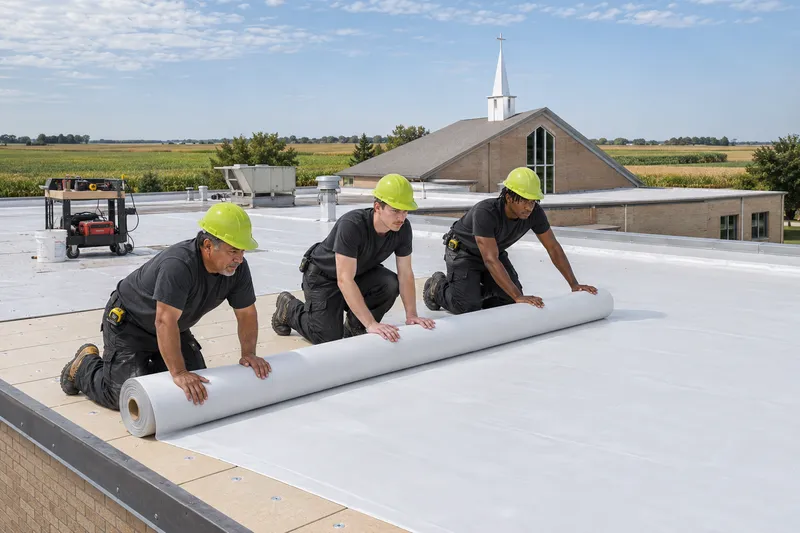
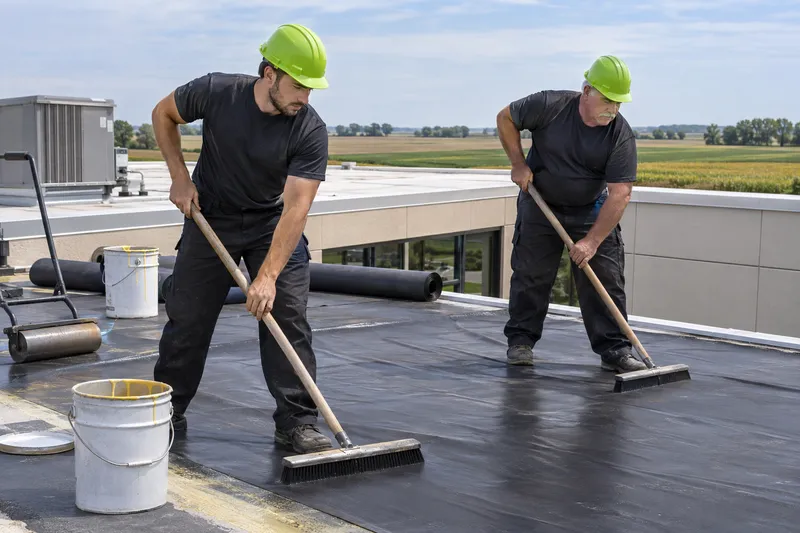
Harvard commercial roofing on older main-street buildings usually means three jobs at once: thin or wet insulation, worn membrane, and parapet flashing that has slid down or pulled loose from the brick wall.
Doing all three together costs less than coming back for the parapets later, and the new roof ties into the wall correctly the first time, with flashing terminated high and sealed.
Older flat roofs in Harvard tend to show these conditions when it is time for a new roof.
Older roofs often sit on thin board or none at all. New insulation under the membrane lowers heat loss through the top of the building. Thicker board also raises the roof, so wall flashing is checked first.
Base flashing slides down the wall as the roof ages, leaving a gap where rain runs behind it. New flashing gets fastened and terminated high. Termination bar and sealant hold the new flashing at the top edge.
Cap stones on top of parapets shift and open their joints. Water enters the wall from above and shows up inside as a stain. Resetting and sealing the coping closes the wall from above.
Old decks sag between supports and hold water. Tapered insulation slopes the new roof toward the drains. Leaving them in place keeps aging the new membrane at those spots.
Edges patched many times show layers of tar and tape. A new membrane replaces the patches with one continuous sheet. Each patch layer adds weight and hides wet board underneath.
Steel shop roofs show backed-out screws and dried laps. Refastening or new panels stop the drips. Many Harvard shops pair a steel roof with a small flat office roof.
Low-slope main-street roofs take membrane, and pitched shops take steel.
Main-street roofs that want a white welded sheet tied up the parapet walls.
TPO Roofing detailsOlder flat roofs with pipes and vents where flexible rubber flashing closes each opening.
EPDM Roofing detailsPitched shops and storage buildings with worn screw-down panels.
Commercial Metal Roofing detailsLarger processing or storage buildings where the work is phased around operations.
Industrial Roofing detailsStains along an outside wall often start at the parapet. We check the coping, flashing, and membrane on the same roof walk.
Before and after, the biggest changes are at the walls and under the membrane.
Flat main-street roofs are rebuilt from the deck up, with the walls done in the same pass.

We walk the roof and parapets, take core cuts, and check coping joints and base flashing along every wall. A photo set of each wall goes with the proposal.
Old membrane and wet board come off, and soft or rusted deck is replaced before anything new goes down. Debris goes down a chute to an alley dumpster.
New insulation goes down, with tapered sections that slope water away from walls and toward drains. Board seams are staggered between layers.
The chosen membrane covers the field, then turns up each parapet wall as base flashing. Seams are welded or taped and checked by hand.
Flashing is fastened and terminated high on the wall, and loose coping is reset and sealed. Scuppers and drains are flashed before the final walk.
Harvard is part of our service area along with Hastings and four other towns.
Building elsewhere? call us or send us a message.
Home base for our commercial roofing work.
Smaller shop and co-op roofs with layer and ponding questions.
Downtown storefront roofs and ag buildings with staged deliveries.
Brick downtown roofs with masonry counterflashing.
Metal shop roofs and farm-service buildings.
Low-slope main-street roofs take TPO or EPDM, and pitched shops and storage buildings take metal. Older flat roofs usually need new insulation and parapet flashing too, while metal buildings need new panels or retrofit framing.
Insulation and wall work move the number most. Replacing thin board and rebuilding parapet flashing adds labor beyond the membrane itself, and wet insulation found in core cuts adds more.
Call us with the address. Small main-street roofs get the same roof walk, core cuts, and written scope as large ones.
Yes. Parapet flashing and coping work can be done alone on a sound roof, or with a new membrane when the roof is also worn.
Thicker insulation raises the roof surface, so flashing height and coping are checked before the board is ordered. The scope shows the new flashing height.
Work runs section by section from the back of the building forward, material moves through the alley, and each section is sealed before the crew leaves for the day.
Damaged deck is cut out and replaced as soon as it is exposed, before insulation goes down. The proposal lists a per-sheet price so deck repairs are clear before work starts.
Shared parapets get flashed on your side, and we coordinate with the neighboring owner when flashing or coping crosses the wall. The scope shows which side of the wall the work covers.
Call or request an estimate. We check the roof, the insulation, and the parapets in one visit.