Worn Gravel Built-Up Roofs
Bare spots in the gravel, cracked bitumen, and blisters show a built-up roof near the end. Tear-off and a welded TPO sheet replace the heavy gravel with a light membrane.
As a Hastings TPO roofing contractor, we install white TPO membrane on flat and low-slope commercial roofs and weld every seam with hot air.
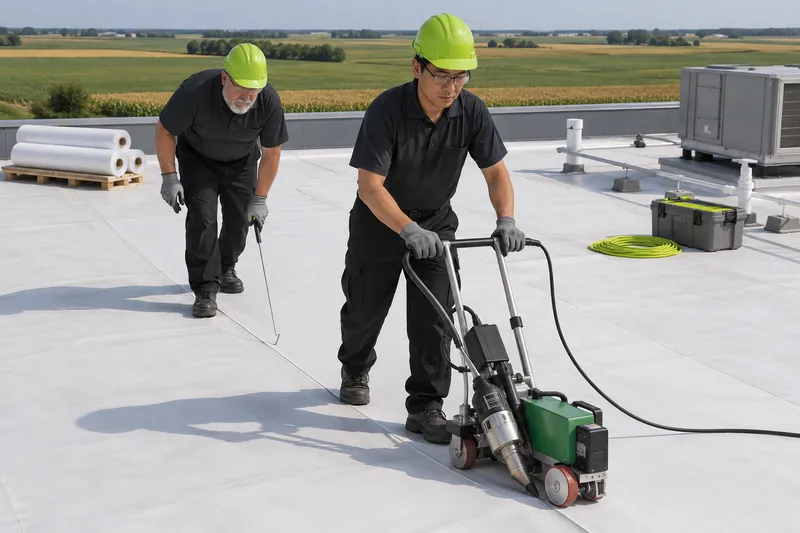
Hastings TPO roofing works best on flat and low-slope decks where a white, welded membrane can run in long sheets between drains and curbs.
| Roof Detail | Fits TPO Now | Check First |
|---|---|---|
| Slope | Flat or low-slope deck | Pitched sections over 3 in 12 go to metal |
| Deck | Steel, wood, or concrete in good shape | Rusted or soft deck gets replaced first |
| Old roof | One layer, or a clean tear-off | Two existing layers mean a full tear-off |
| Equipment | Rooftop units on raised curbs | Units sitting low need new curbs |
| Exhaust | Office and retail exhaust | Grease exhaust needs a rated membrane |
TPO goes on when the old roof has reached one of these conditions and patching keeps failing.
Bare spots in the gravel, cracked bitumen, and blisters show a built-up roof near the end. Tear-off and a welded TPO sheet replace the heavy gravel with a light membrane.
Black rubber that pulls away from walls and curbs stresses every flashing. A TPO install over new insulation resets the edges with welded flashing.
Water that sits for two days after rain points to a sagging deck or crushed insulation. Tapered board under the TPO slopes it back to the drain.
Dark roofs soak up summer sun and push heat into the floor below. A white TPO surface reflects much of it back off the roof.
Bubbles in torch-down or cap sheet trap water and split open with foot traffic. The blistered layer comes off before new TPO goes on.
Ceiling stains under rooftop units often trace back to cracked flashing at curb corners. TPO uses prefab corners welded straight to the field sheet.
A TPO roof is more than the white sheet. Under it sits polyiso insulation, often a cover board to stand up to foot traffic, and fasteners or adhesive sized to the deck type and the wind design for the building.
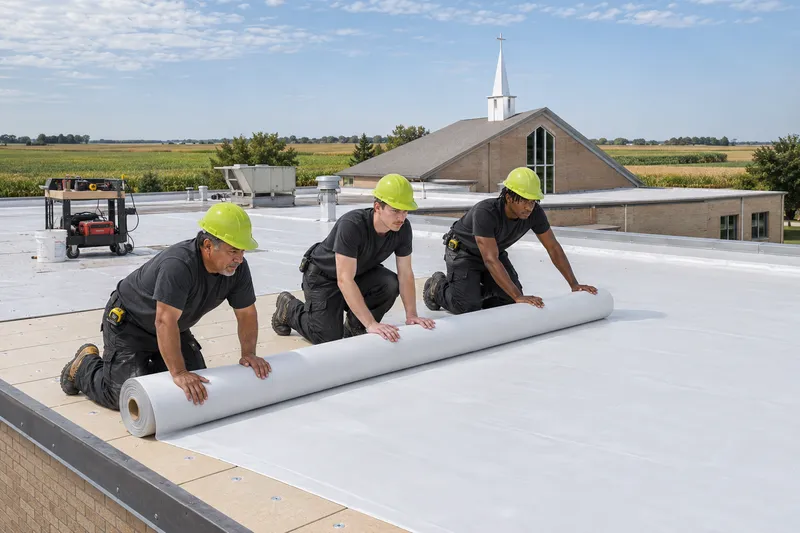
We roll the membrane in long runs, overlap each sheet, and weld the laps into one piece. Curbs, walls, and drains get TPO flashing welded to the same sheet, so the roof has no glued joints to dry out.
What owners see on the roof before the install, and what the TPO roof looks like when the crew leaves.
Book a roof walk. We take core cuts, check the deck, and tell you whether TPO fits before we price it.
TPO goes on in the same order each day, so every section is closed and welded before the crew leaves.

Core cuts and a moisture check show how many layers sit on the deck and where insulation is wet. That sets the tear-off line for each section.
Old roofing comes off one section at a time and drops down a chute to a dumpster. Rusted or soft deck is cut out and replaced before new board goes down.
Polyiso goes down in staggered layers, tapered toward drains where the roof ponds, then gets fastened or glued to the deck.
TPO rolls out over the board, each sheet overlapping the last. A robotic hot-air welder fuses the laps after a test weld sets the heat for the day.
Curbs, walls, and drains are flashed with welded TPO. Every seam then gets probed by hand, and any cold spot is rewelded on the spot.
Rubber sheet with taped seams fits roofs crowded with pipes, where flexible flashing makes the many penetrations easier to close.
Compare EPDM roofingPlants with exhaust fans and heavy curbs often get TPO too, phased around shifts and forklift traffic below.
See industrial roofingPitched wings next to a flat TPO roof usually take steel panels, joined at the roof break with a transition flashing.
See metal roofingTPO is a single-ply thermoplastic sheet laid over insulation on a flat or low-slope roof. Its white surface reflects sun, its seams are welded with hot air, and it attaches by fasteners, adhesive, or ballast to suit the deck and wind design.
Hot air melts the overlapping edges of two sheets, and a roller presses them together until they cool into one piece. We run test welds each morning, since air temperature and wind change the settings, then probe every finished seam.
Membrane thickness, insulation thickness, fastened versus fully adhered attachment, and how much old roof comes off set most of the price. Curbs, parapet walls, and penetrations add flashing time, and deck repairs add material.
Long service comes from a thick membrane, good welds, and steady upkeep. Thicker sheets carry longer maker ratings, while ponding, hail, UV, and traffic around units wear any sheet down. Yearly seam checks and fast puncture repairs matter more than one spec-sheet number.
Weld quality is the main risk, since a cold seam can open years later. Thin sheets puncture from hail or dropped tools, the white surface needs cleaning to stay reflective, and formulas differ between makers, so the spec sheet matters.
National Weather Service records list a normal Hastings snowfall of 28.6 inches a season, so drains and scuppers have to stay clear. Drifts pile against parapets and rooftop units, and meltwater that refreezes at a blocked drain can back up under flashing and find a weak seam.
Request an estimate or call. We walk the roof, take core cuts, and write the TPO scope detail by detail.