Water That Sits for Days
Ponding rings around low spots and drains mean the deck or insulation has sagged. Standing water ages membrane faster, and new tapered insulation can move it toward a drain.
As a Hastings commercial roofing contractor, we tear off worn roofs and install TPO, EPDM, and metal systems on commercial and industrial buildings.
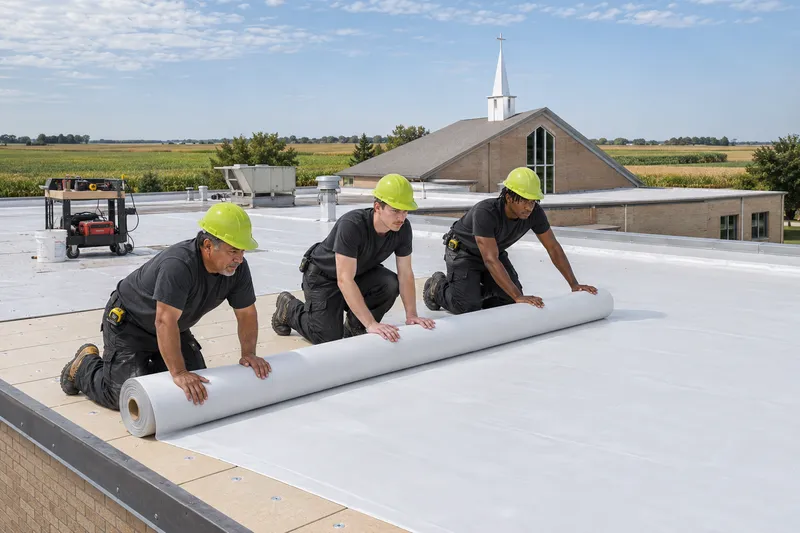
Hastings commercial roofing starts with matching the system to the roof slope, the seams, and what sits on the roof. These are the three systems we install most.
| Roof Detail | TPO | EPDM | Metal |
|---|---|---|---|
| Roof slope | Flat and low-slope decks | Flat and low-slope decks | Pitched shops and metal buildings |
| How seams close | Hot-air welded into one sheet | Seam tape and primer | Standing seams or lapped panels with fasteners |
| Surface color | White, reflects summer sun | Black rubber, stays flexible in cold | Painted steel in several colors |
| Common buildings | Offices, retail, churches, schools | Older flat roofs, buildings with many penetrations | Implement shops, storage, co-op buildings |
| Watch for | Weld quality at every lap | Seam tape aging and perimeter shrinkage | Fastener backout and lap sealant |
Industrial roofs can use any of the three, chosen by exhaust, foot traffic, and how much weight the structure carries.
These are the roof conditions that most often turn a repair call into a new roof on Hastings commercial buildings.
Ponding rings around low spots and drains mean the deck or insulation has sagged. Standing water ages membrane faster, and new tapered insulation can move it toward a drain.
Laps that lift at the edge let wind-driven rain under the sheet. On older EPDM the seam adhesive dries out; on TPO a cold weld can open years after install.
A roof that gives when you walk on it usually has wet insulation below. Wet board holds water against the deck and has to be cut out before any new roof goes down.
Panels on Hastings shop buildings move with every hot day and cold night. That movement backs screws out, cracks washers, and lets water track along the panel ribs.
Curbs, pipe boots, and exhaust fans are where flashing fails first. Stains on the ceiling tile under a rooftop unit are a common first sign.
Hail and dropped tools leave dents, cracks, and small holes in membrane. One puncture near a drain can soak a large area of insulation before anyone sees a drip.
Each service below has its own page with the roof conditions, the steps, and the questions owners ask most.
White single-ply membrane with hot-air welded seams, installed over new insulation on flat and low-slope roofs. A good fit for offices, retail strips, and churches that want a reflective surface.
Hastings TPO roofingBlack rubber membrane, fully adhered or mechanically fastened, with taped seams. EPDM stays flexible through freeze and thaw and handles roofs crowded with vents and pipes.
Hastings EPDM roofingLarge low-slope and metal roofs over plants and processing space, phased around shifts and equipment. Exhaust fans, curbs, and walkway pads get detailed as part of the roof.
Hastings industrial roofingStanding-seam and exposed-fastener panels for shops, storage, and co-op buildings, including retrofit framing over an old roof where the structure allows it.
Hastings commercial metal roofingTell us where the water shows up inside and what sits on the roof above it. We start every job with a roof walk.
A new commercial roof follows the same order on every building, from the first roof walk to the last flashing.

We walk the whole roof, mark wet areas, count layers, and check drains, curbs, and edge metal. Core cuts show what sits under the membrane.
Slope, rooftop equipment, budget, and how the building is used decide between TPO, EPDM, and metal. The written scope names the system and each detail.
Hastings issues roofing permits through its Building and Inspection office. Permit, crane, and material dates get set before tear-off begins.
Old roofing comes off one section at a time, damaged deck gets replaced, then insulation and membrane go down. Each section is closed watertight before the crew leaves.
Curbs, drains, walls, and edge metal are flashed last. A final roof walk checks every seam and termination with you.
A new roof changes how the building handles water, heat, and the people who service equipment on top of it.
We install commercial roofs in Hastings and in the five towns below.
Outside these towns? call us or send us a message.
Downtown storefront roofs and grain-handling buildings where crane and truck staging need planning ahead.
Farm-service shops and metal buildings that need new panels or retrofit framing.
Main-street flat roofs that need insulation and parapet flashing replaced together.
Older brick downtown buildings with scuppers, parapets, and masonry counterflashing.
Shops and co-op buildings where layer counts and ponding decide the scope.
Service life comes down to the system, the install, the drainage, and the upkeep. TPO, EPDM, and metal each carry their own maker ranges, and ponding, hail, and traffic near equipment shorten all of them. Two inspections a year and quick repairs keep a roof at the long end.
Pick TPO for a white, reflective surface with welded seams. Pick EPDM for black rubber that stays flexible in a Nebraska winter. We weigh roof size, the equipment on top, energy goals, and budget before recommending one.
Ask for a written scope that names the system, who pulls the city roofing permit, and how rooftop units and the interior are protected during tear-off. Then compare bids line by line, since square footage and flashing details often differ between quotes.
Roof size and the new system set the base price. Tear-off of old layers, wet insulation, damaged deck, the number of curbs and drains, parapet walls, crane access, and work during business hours all add to it.
Nebraska law adopts the 2018 International Building Code and the 2018 International Existing Building Code as the state building code. Hastings enforces its own adopted code or the state code, and Hastings Development Services confirms the edition and local amendments for each project.
Call or request an estimate. We walk the roof first and price the system that fits it.