Backed-Out Screws
Daily heating and cooling works panel screws loose until the washers stop sealing. Each loose screw becomes a small leak along the panel rib. Larger replacement screws with new washers reseal the holes.
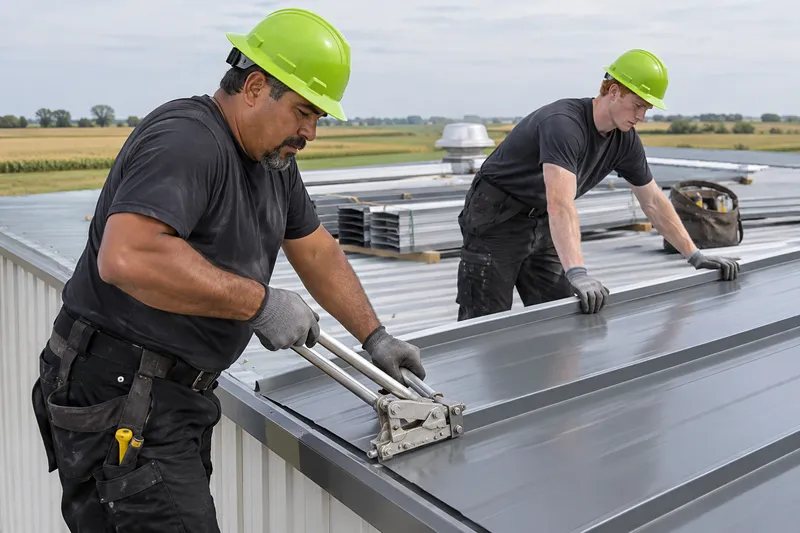
As a Hastings commercial metal roofing contractor, we install standing-seam and exposed-fastener steel panels, and we repair and refasten worn metal roofs.
Hastings commercial metal roofing fits pitched shops, storage buildings, and pre-engineered metal buildings, plus flat roofs where retrofit framing adds a pitch.
| Building Detail | Fits Metal Now | Check First |
|---|---|---|
| Slope | Pitched roof or retrofit framing | Dead-flat roofs need framing first |
| Structure | Purlins in good shape | Added framing weight needs a load check |
| Old roof | Worn panels or a flat membrane | Wet insulation under it gets checked |
| Use | Shops, storage, co-ops, offices | Heated spaces need insulation and a vapor plan |
| Panels | Standing seam or screw-down | Low pitches suit standing seam better |
These are the metal roof conditions we find most on shop and storage buildings around Hastings.
Daily heating and cooling works panel screws loose until the washers stop sealing. Each loose screw becomes a small leak along the panel rib. Larger replacement screws with new washers reseal the holes.
Butyl tape between panel laps hardens and shrinks with age. Water then wicks along the lap toward the purlin and drips inside. Fresh tape at every lap stops the wicking.
Panel ends and cut edges at the eave rust first, then the rust spreads under the paint. Badly rusted panels get replaced. Primer on cut edges slows new rust on replacement panels.
Uninsulated panels sweat on cold mornings and drip like a leak. Insulation and a vapor retarder under new panels stop most of it. A vapor retarder keeps warm, damp air off the cold steel.
Where a metal roof meets a wall or a taller building, bent flashing and old caulk let water in. New flashing is formed to fit. Counterflashing set into the wall covers the joint for good.
Snow sheds off steel in sheets and can tear gutters loose or land on doorways. Snow guards hold it on the roof. Gutters and doorways below stay clear of falling snow.
Standing-seam panels hide their fasteners inside clips that let the steel move with temperature swings. Exposed-fastener panels screw straight through the flat of the panel into the purlin, cost less up front, and need screw checks over the years.
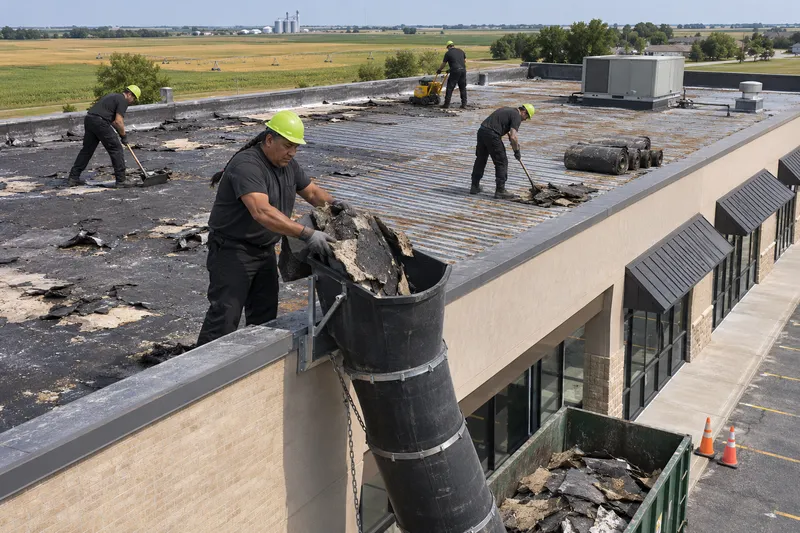
On a worn flat roof, retrofit framing can set new purlins over the old roof so steel panels shed water at a pitch, with insulation added in the new space.
What a worn metal roof shows before the work, and what it looks like after.
Tell us the building size and what you see at the screws and laps. We check whether refastening or new panels fit better.
Metal roofing follows a set order from the structure up, so the panels sit straight and the trim seals.
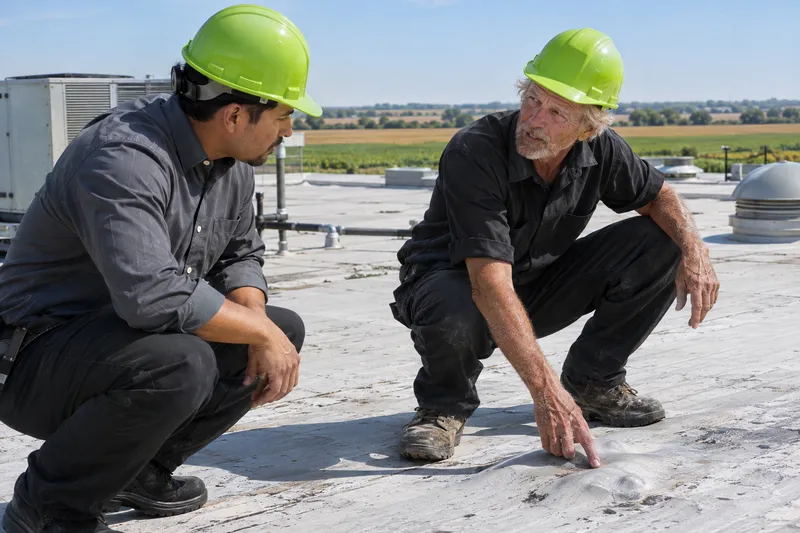
We check panels, fasteners, laps, and purlins, and look for wet insulation or rot under the old roof before any panel is ordered.
Panels are ordered in full lengths from eave to ridge where possible, which keeps end laps off the roof.
Damaged purlins get replaced. On flat roofs, retrofit framing goes on first to give the new panels their pitch.
Insulation and vapor retarder go down, then panels are set on clips or screwed with new washered fasteners in straight rows.
Ridge caps, eave trim, and wall flashing seal the edges. Snow guards go above doors and walkways where snow would slide.
Flat office wings beside a metal shop usually get welded TPO, tied to the metal roof at the transition.
See TPO roofingLow-slope additions too flat for panels can take EPDM, flashed up to the metal wall.
See EPDM roofingLarge pre-engineered plant buildings get new panels installed in phases around production.
See industrial roofingOften, yes, with a retrofit framing system. New purlins fasten to the structure and the panels span over the old roof. The structure has to carry the added weight, and wet insulation or rotten deck underneath gets checked first.
Panel type, steel gauge, roof size, and roof shape set the base. Standing seam costs more than screw-down panels, and insulation, trim, snow guards, tear-off or retrofit framing, crane access, and penetrations add to it.
Loose fasteners, failing lap sealant, and rust at cut edges cause most leaks. Panel movement works screws loose, poor wall flashing lets water in, and uninsulated panels drip condensation. Regular fastener checks and flashing repairs handle most of it.
Standing seam fits buildings that want hidden fasteners and room for the steel to move. Exposed-fastener panels fit budget-driven shops and storage with steeper pitches but need periodic screw checks. Slope, use, and planned service life guide the pick.
Per-foot price swings with panel type, gauge, insulation, trim, and whether framing or tear-off comes first. A roof walk and measured takeoff give a real number for your building.
Yes, when the steel is solid and leaks trace to screws and laps. Refastening swaps every screw for a larger one with a new washer and reseals the laps, which costs far less than new panels.
Snow slides off steel in sheets, so snow guards make sense above doors, walkways, gutters, and lower roofs. They hold snow on the panels until it melts off in smaller amounts.
Request an estimate or call. We check the fasteners, laps, and purlins, then recommend repair or new panels.