Residue Around Exhaust Fans
Process exhaust leaves grease or chemical film that softens some membranes. The sheet around the fan breaks down long before the rest of the roof. A rated sheet in that zone keeps the rest of the roof from paying for it.
As a Hastings industrial roofing contractor, we install new roofs over plants and warehouses in phases, working around shifts, exhaust fans, and heavy rooftop equipment.
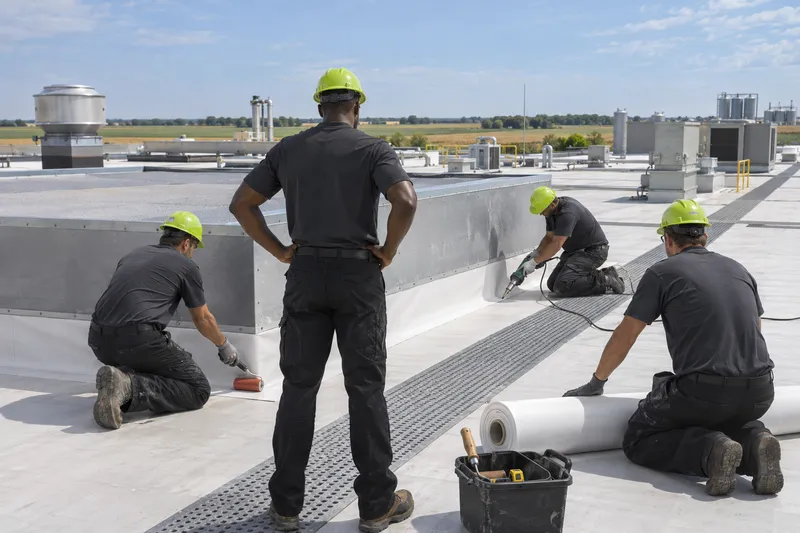
Hastings industrial roofing starts with what the roof carries and what the building does underneath it, since both shape the system and the schedule.
| Plant Detail | Ready Now | Plan Around |
|---|---|---|
| Exhaust | Office and dry process exhaust | Grease or chemical exhaust needs a rated sheet |
| Equipment | Units on raised curbs | Units lifted or disconnected for the membrane |
| Production | Planned shutdown windows | Hot work near flammable process lines |
| Structure | Deck rated for the new load | Added ballast or panels need a load check |
| Access | Room for crane and dumpster | Forklift lanes kept clear below |
Plant roofs fail in their own ways, mostly around equipment, exhaust, and traffic.
Process exhaust leaves grease or chemical film that softens some membranes. The sheet around the fan breaks down long before the rest of the roof. A rated sheet in that zone keeps the rest of the roof from paying for it.
Large units shift on their curbs with vibration, cracking the flashing at the base. Water then runs inside the curb and down the deck. Taller curbs and new base flashing stop the water at the unit.
Technicians walking the same route to each unit grind through the membrane. A clear path of wear marks where walkway pads belong. Pads also tell technicians where to walk on the new roof.
Wide roof bays deflect under snow and equipment, leaving water in the middle of each bay. Tapered insulation corrects the slope. Water left in a bay adds weight the structure carries all winter.
Older metal plant roofs rust along laps and at fastener holes. New panels or a membrane over retrofit framing replace them. Panel replacement can run in phases like a membrane job.
Debris from vents and dust from production clogs drains and strainers. Backed-up water finds every weak lap nearby. New strainers and a cleaning schedule keep them open.
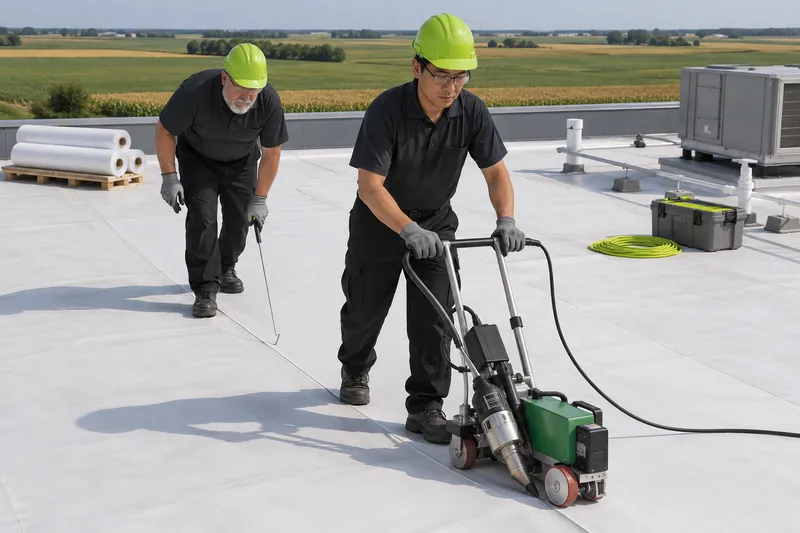
On a plant roof, the membrane has to run under or around every unit, duct, and fan. Equipment is often lifted on raised curbs or disconnected for a short window so the new sheet can pass beneath it and be flashed up the curb.
We plan shutdowns with your maintenance staff and mechanical contractor, protect open areas below from debris, and lay walkway pads along each service route.
A new industrial roof changes what maintenance staff deal with every week.
Tell us the shift schedule and the equipment on the roof. We build the phasing plan around both.
Each phase is closed watertight before the next one opens, so production below keeps running.

We walk the full roof with maintenance staff, core the insulation, and mark every exhaust, curb, and drain that needs special detail.
A written phasing plan sets crane spots, staging, and which bays get roofed on which days, matched to your shifts and shutdowns.
Units are raised or disconnected, open areas below get debris protection, and hot-work permits with fire watch are set where needed.
Tear-off, deck repair, insulation, and membrane happen bay by bay. Each night ends with a tie-in that keeps finished bays dry.
Walkway pads go down along service routes, equipment is reset, and we walk the roof with your maintenance lead.
Welded white sheet works on most dry-process plant roofs and keeps upper floors cooler in summer.
See TPO roofingFlexible rubber handles plant roofs with heavy movement and many small penetrations away from grease exhaust.
See EPDM roofingPre-engineered plant buildings with pitched roofs take new steel panels or framing over the old roof.
See metal roofingIt covers the large low-slope or metal roofs over production, warehouse, and processing space. These roofs carry fans, ductwork, and heavy units, and the system is chosen for exhaust exposure, process heat, and the load the structure carries.
TPO, EPDM, PVC, and standing-seam or exposed-fastener metal all work on plants. Grease or chemical exhaust calls for a membrane rated for it, metal fits pitched pre-engineered buildings, and insulation board under membranes adds R-value.
Equipment sits on raised curbs, pipes get boots, and flashing rises well above the roof surface. Units are often lifted or disconnected so the membrane runs under them, and walkway pads protect the new roof along service routes.
Expect a written phasing plan, crane and staging locations, and debris control over open areas. Hot work near flammable processes needs permits and fire watch, and daily tie-ins should keep each finished section watertight overnight.
Yes, in most cases. Phasing keeps work over one bay at a time, and noisy or hot work is scheduled for planned shutdowns or off shifts where the process requires it.
Exhaust zones need a membrane rated for that exposure, set by what the fan discharges. We match the sheet near each fan to the exhaust and use the standard sheet across the rest of the roof.
Tear-off over open production space is limited to small sections, with protection hung or laid below where the deck has gaps. Debris goes down an enclosed chute or by crane, away from doors and loading lanes.
Request an estimate or call. We walk the plant roof with your maintenance lead and write a phasing plan with the scope.