Glued Seams Coming Apart
Older EPDM joined with liquid adhesive lets go as the glue ages. New EPDM uses seam tape and primer along every lap. Taped laps hold up longer than the old glue joints did.
As a Hastings EPDM roofing contractor, we install black rubber membrane on flat commercial roofs, taping every seam and rebuilding flashing at each pipe and curb.
Hastings EPDM roofing fits flat roofs where flexibility counts: many penetrations, older decks that move, and buildings that see hard freeze and thaw.
| Roof Detail | Fits EPDM Now | Check First |
|---|---|---|
| Slope | Flat or low-slope deck | Steeper pitches take metal panels |
| Penetrations | Many pipes, vents, and conduits | Grease exhaust needs a different sheet |
| Insulation | Dry board or full replacement | Wet board is cut out before install |
| Attachment | Adhered, fastened, or ballasted | Ballast needs a deck rated for the weight |
| Surface | Black is fine for the building | Cooling-heavy buildings compare white TPO |
These conditions on an existing roof point toward a new EPDM system.
Older EPDM joined with liquid adhesive lets go as the glue ages. New EPDM uses seam tape and primer along every lap. Taped laps hold up longer than the old glue joints did.
Shrinking rubber tugs at the perimeter until edge metal lifts. A new adhered sheet with new termination bar fixes the edge from the deck up. Loose edge metal also lets wind get under the sheet.
Roofs with dozens of vents, pipes, and conduits are hard to keep sealed. Stretchy EPDM flashing wraps odd shapes that rigid pieces struggle with. Each opening gets its own molded boot or wrap.
Ballast stones moved by wind leave low spots that hold rain. Tapered insulation under a new adhered sheet sends that water to the drains. Loose ballast also wears holes in the sheet below it.
Water that gets in at a split seam spreads through the insulation below. Core cuts find it, and the wet board comes out before the new sheet goes down. Leaving it in place traps moisture under the new roof.
Nebraska winters swing above and below freezing many times. EPDM stays flexible in the cold, which keeps seams and flashing from cracking. Rigid sheets and caulk joints crack where rubber bends.
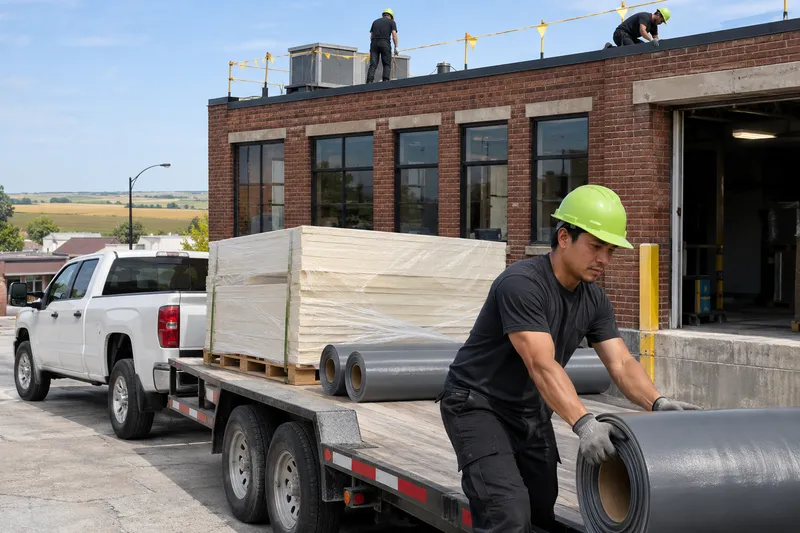
EPDM comes in wide rolls, so a large flat roof has fewer seams to close. The sheet goes down fully adhered, fastened through plates along the laps, or held by ballast where the deck carries the extra weight.
Seams get primed and joined with seam tape, then rolled by hand. Pipes, curbs, and walls are wrapped in uncured flashing that molds to each shape and cures in place on the roof.
The difference shows most at the seams, the edges, and around the equipment.
Call with the roof size and what sits on it. We will tell you whether a full replacement or a seam repair fits better.
EPDM is installed section by section, with every seam primed and taped before the day ends.
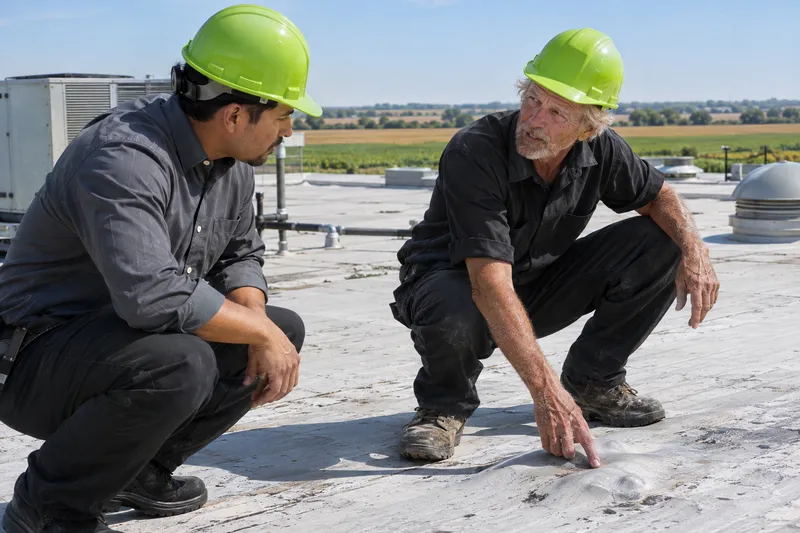
We walk the roof, cut cores, and map wet insulation and failing seams so the tear-off and repair lines are drawn before work starts.
The old membrane and wet board come off down to the deck. Ballast, if any, is hauled away or set aside for reuse.
New polyiso goes down and gets fastened, with tapered pieces where water used to sit near drains and walls.
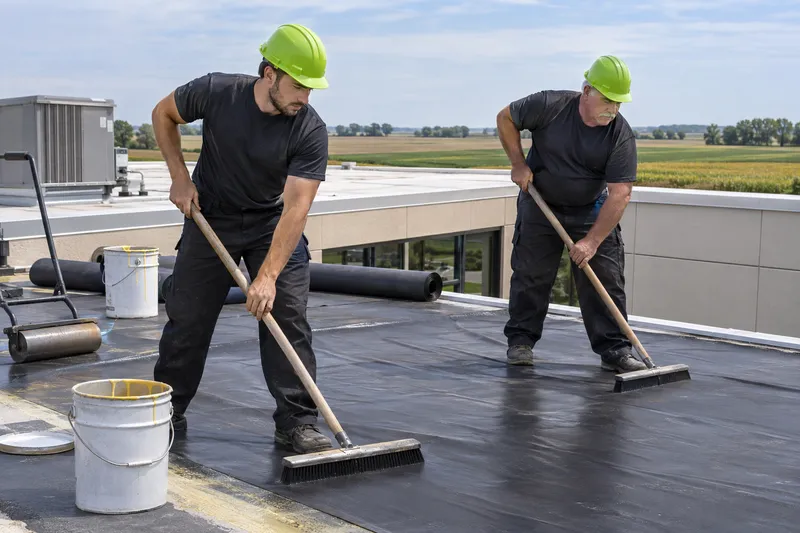
Adhesive is rolled onto the board and the back of the sheet, then the EPDM membrane is laid and broomed flat to push out air.
Seams get primer and seam tape, then a hand roller. Pipes and curbs are wrapped with molded flashing and sealed at the top edge.
Reflective white sheet with welded seams, a common choice when summer cooling costs matter more than winter flexibility.
Compare TPO roofingBig plant roofs can use EPDM on sections without grease exhaust, installed in phases around production schedules.
See industrial roofingSteel panels over retrofit framing replace a flat rubber roof when the owner wants a pitched roof that sheds water.
See metal roofingReplacement removes the old membrane, checks the deck and insulation, and lays new rubber sheets. Wet board is cut out, the new sheet is adhered, fastened, or ballasted, seams are primed and taped, and every curb, wall, and drain gets new flashing.
Sheet thickness, reinforcement, and how the sheet attaches drive the material and labor. Wide sheets save seam work on open roofs, while many penetrations, layers of old roof, and wet insulation add hours and board.
Life depends on sheet thickness, seam quality, and upkeep. Rubber handles freeze and thaw well, so aging seam tape, edge shrinkage, and punctures usually end its service. Regular seam checks and fixing pulled flashing keep it working longer.
Seam separation, shrinkage, and punctures top the list. Glued seams open as adhesive ages, shrinkage pulls flashing off walls and curbs, and hail or foot traffic near units can puncture the sheet. Black rubber also runs hot in summer.
Sometimes, when the existing roof is a single dry layer and the deck is solid. A recover board goes down first. Two existing layers or wet insulation mean a full tear-off instead.
EPDM stays flexible well below freezing, which helps seams and flashing ride out freeze and thaw without cracking. Snow load and blocked drains matter more than cold itself, so drains and scuppers need to stay clear through winter.
Yes. Punctures and small seam openings get cleaned, primed, and covered with a patch of seam tape or cured rubber. Patches hold best when the sheet around them is still flexible and the insulation below is dry.
Request an estimate or call. We map the seams and wet areas first, then write the EPDM scope.